The Washington, D.C. field trip
I'd Like to Apologize to Every Teacher I Ever HadThe Washington, D.C. field trip is a pivotal educational excursion in Tony Danza’s year at Northeast High School. Proposed as an alternative to returning to Los Angeles for a short Thanksgiving break, the trip initially represents a compromise: Tony wants to take his students to Manhattan, but the network prefers Washington, D.C., because it is less expensive, unfamiliar to the students, and offers access to the Folger Shakespeare Library. What begins as a production-friendly field-trip segment becomes evidence of the students’ capacity to engage when learning is social, concrete, and connected to places of historical meaning.
Causes and Background
Tony’s desire for a major excursion grows out of personal disappointment. He cannot justify flying home to Los Angeles for only a few days, and the prospect of missing Thanksgiving leaves him feeling isolated from his wife and children. A trip with his class offers both a change of pace and a way to share something memorable with the twenty-six students entrusted to him. The production team immediately likes the idea, but the network redirects the destination from Manhattan to Washington, D.C. The revised plan is approved by the school administration for November 16, and every student must bring a signed permission slip.
The trip also exposes the fragile disciplinary structure at Northeast High School. The school has posted rules concerning uniforms, hoodies, iPods, running, and shouting, yet those rules are not consistently enforced. Serious consequences are generally reserved for students who fight, while teachers often avoid disciplinary confrontations that would consume valuable class time and destroy classroom momentum. Tony therefore worries not only about what might happen in Washington, but also about whether students who test boundaries at school will behave on a bus and in public institutions. His anxiety is intensified by the scale of Northeast itself, the largest high school in Philadelphia, with three stories, trailers, multiple sports fields, a football stadium, cavernous gyms, and even its own Philadelphia police station.
Departure and Journey
At six o’clock on the morning of November 16, Tony waits in freezing weather on a corner outside Northeast, pacing because the chartered bus is late and no students have appeared. The other chaperones arrive over the next fifteen minutes: Al G’s math teacher Ms. Green, David Cohn, and Kelly Barton, Northeast’s retired former principal and the production’s liaison to the school district. Kelly tells Tony to stop worrying, but Tony remains convinced that he has taken the group far beyond his comfort zone. The production team arrives, and all twenty-six students appear at approximately 6:28, just as the bus does. The delayed departure turns Tony’s abstract fear into a concrete test of organization and trust.
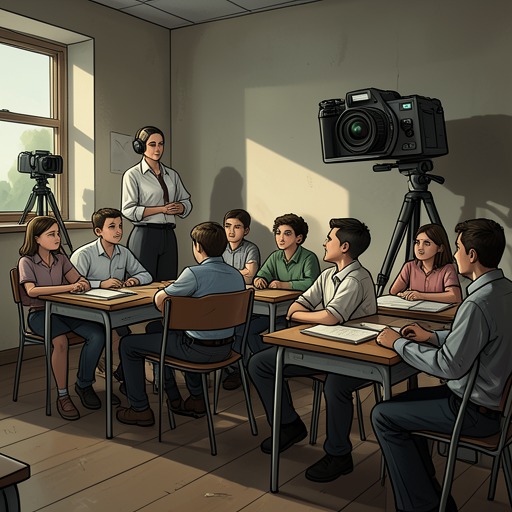
Because cameras record the entire excursion, the day is not a conventional field trip. The production provides quality boxed lunches, and Tony deliberately plans activities that will keep students participating rather than sleeping or staring out the windows. A road-spotter game using an iPhone application develops into a lively competition between students and teachers. Tony brings his ukulele and stages a sing-along, first playing older songs unfamiliar to the students and then surprising them with Rihanna’s “Umbrella,” which he learned from an Internet video specifically for the trip. Even Fred, the bus driver, joins in. By the time the group reaches Washington, the combination of food, music, competition, and shared anticipation has eased the tension that dominated the morning.
Historical and Literary Learning
The first visible change occurs as the students recognize buildings they have previously encountered only in books. Their reactions to Washington’s landmarks excite Tony because the city is no longer an abstract civic setting; it has become a physical environment they can read and interpret. Fred supplements the excursion by acting as a tour guide, driving the group as close as possible to the White House and the Washington Monument. Tony tells Nakiya about visiting Washington at thirteen with his Boy Scout troop and winning a race to the top of the monument, adding a personal memory to the students’ encounter with national history.
At the Folger Shakespeare Library, the class responds to an exhibit of vintage Shakespearean texts and illustrations with unexpected enthusiasm. When Katerina points out that Julius Caesar is dying, the students crowd around the display and discuss Roman clothing, geography, language, and Shakespeare’s decision not to write the play in Latin. Their excitement resembles the intensity they usually reserve for popular music, but the object of their attention is now a canonical literary work. Tony is surprised and delighted by the engagement, particularly because several students, including Nakiya, have an ongoing conflict with their Latin teacher.
The students then enter an Elizabethan replica theater, where the acting troupe Bill’s Buddies performs scenes from several Shakespeare plays and invites the class onto the stage. Nakiya, Chloe, and Eric Lopez immediately show themselves to be natural performers, while Monte and Eric Choi also participate despite the risk of looking foolish. The students laugh so hard that they may not realize they are learning, yet their responses to questions from the troupe demonstrate substantial knowledge of Julius Caesar. Their public performance converts literary comprehension into action: they do not merely discuss the play in a classroom but embody its theatrical possibilities.
After the Folger Library, the class visits the National Archives for collaborative exercises on the Constitution. Students become temporary archivists, selecting and analyzing diaries, letters, and memoirs for evidence of constitutional issues such as separation of church and state and checks and balances. They then locate the relevant principles in the Constitution itself. The exercise links national political concepts to ordinary people’s records and daily lives, rather than presenting the Constitution as a remote document. Even students Tony considers unmotivated begin working. Their participation demonstrates the practical value of learning that is interactive, cooperative, and tied to primary sources.
The students divide into teams, each researching a different set of records. White Nick and Ben-Kyle take responsibility for filming the class, with Nakiya serving as narrator, and the resulting DVD is brought back to school. Their uniforms, research work, filming, and narration make them look like genuine archivists, allowing the class to produce its own record of learning rather than remaining merely the subject of the television crew’s record.
Consequences and Significance
At the Lincoln Memorial, the students become so absorbed in the atmosphere of history that they behave with unusual reverence while looking up at the enormous stone likeness of Abraham Lincoln. They pose for group photographs with the Washington Monument in the background, and Tony promises to copy and frame a picture for each student. Later, they release some of their energy by chasing geese around the Reflecting Pool. The day moves between solemn attention and youthful play, suggesting that discipline and enjoyment are not opposites when students feel genuinely involved.
Tony judges the excursion one of the best days of the year and hopes the students will remember it as vividly as he remembers his own Washington trip as a young Boy Scout. The comparison gives the event a generational dimension: a place that once shaped Tony’s memory now becomes part of his students’ memories. Yet the trip does not erase ordinary adolescence. On the return journey, Tony catches Russian Playboy making out with his girlfriend, moves him to another seat, and finds him kissing the girl beside him before the bus reaches Philadelphia. The incident produces a scandal among the students and supplies the kind of romantic drama the television production might have wanted, although the director considers it too normal to be useful for the show.
The field trip therefore matters precisely because it exceeds the staged logic of reality television. Tony has insisted that the students come first, that the cameras record what happens rather than manufacture drama. The excursion provides no contrived triumph: it contains lateness, fear, logistical pressure, singing, scholarship, irreverence, romance, and fatigue. Its decisive revelation is quieter and more consequential. When students encounter Shakespeare through performance, the Constitution through original documents, and national history through physical places, even those who appear disengaged can work with concentration and pleasure. Washington does not simply display the students to the cameras; it allows them to display capacities that the ordinary school routine often leaves hidden.